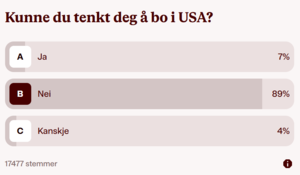
Politikk, religion og samfunn Vi drømte om Amerika....

Diskusjonstråd Se tråd i gallerivisning

  • xerxes

    Æresmedlem
    Ble medlem
    08.01.2005
    Innlegg
    15.359
    Antall liker
    12.224
    Sted
    Holmestrand
    Vi får sende Støre og Stoltenberg over til det Hvite Hus igjen, slik at de kan spøke, bukke og skrape òg latterliggjøre seg selv enda en gang. Da ordner det seg nok...
    Du skjønner at de IKKE har noe valg?
    Kortsiktig så må vi pent bukke og skrape.
     

    lars_erik

    Rubinmedlem
    Ble medlem
    19.10.2006
    Innlegg
    36.981
    Antall liker
    21.511
    Sted
    Hades
    Torget vurderinger
    0
    Du skjønner at de IKKE har noe valg?
    Kortsiktig så må vi pent bukke og skrape.
    Syns du det hjalp? Samme med andre som har prøvd samme geniale taktikk?

    Ting tyder på at respekt fra Trump utenrikspolitisk, er det de som viser styrke som får. Så er det også det med å vise at man ikke er en nikkedukke.

    Til forveksling er det temmelig likt taktikken som ble brukt mot Hitler før WW2. Den var også genial... Bukke og skrape, latterliggjøre seg for mobberen. Det har alltid fungert, skolegården òg ellers i verden. Dialogue og smisking, det løser alt...
     
    Sist redigert:

    erato

    Æresmedlem
    Ble medlem
    15.03.2003
    Innlegg
    21.144
    Antall liker
    13.370
    Sted
    Bergen
    Torget vurderinger
    1
    The Longest Suicide Note in American History

    The Trump administration’s new National Security Strategy targets liberal democracy itself.

    By Anne Applebaum

    Last year, a team of American diplomats from the State Department’s Global Engagement Center traveled to two dozen countries and signed a series of memoranda. Along with their counterparts in places as varied as Italy, Australia, and Ivory Coast, they agreed to jointly expose malicious and deceptive online campaigns originating in Russia, China, or Iran.

    This past September, the Trump administration terminated these agreements. The center’s former head, James Rubin, called this decision “a unilateral act of disarmament,” and no wonder: In effect, the United States was declaring that it would no longer oppose Russian influence campaigns, Chinese manipulation of local politics, or Iranian extremist recruitment drives. Nor would the American government use any resources to help anyone else do so either.

    The recent publication of the Trump administration’s new National Security Strategy showed that this decision was no accident. Unilateral disarmament is now official policy. Because—despite its name—this National Security Strategy is not really a strategy document. It is a suicide note. If the ideas within it are really used to shape policy, then U.S. influence in the world will rapidly disappear, and America’s ability to defend itself and its allies will diminish. The consequences will be economic as well as political, and they will be felt by all Americans.

    Before explaining, I should acknowledge the curious features of this document, which seems, like the Bible, to have several different authors. Some of them use boastful, aggressive language—America must remain “the world’s strongest, richest, most powerful country for decades to come”—and some of them prefer euphemism and allusion. Sometimes these different authors contradict one another, proposing to work with allies on one page and to undermine allies on the next. The views expressed in the document do not represent those of the entire U.S. government, the entire Republican Party, or even the entire Trump administration. The most noteworthy elements seem to come from a particular ideological faction, one that now dominates foreign-policy thinking in this administration and may well dominate others in the future.

    The one genuinely new, truly radical element in this faction’s thinking is its absolute refusal to acknowledge the existence of enemies or to name any countries that might wish America ill. This is a major departure from the first Trump administration. The 2017 National Security Strategy spoke of creating an alliance against North Korea; noted that Russia is “using subversive measures to weaken the credibility of America’s commitment to Europe, undermine transatlantic unity, and weaken European institutions and governments”; and observed that China is “using economic inducements and penalties, influence operations, and implied military threats” to bully others. The 2017 Trump policy team also observed a “geopolitical competition between free and repressive visions of world order.”

    The second Trump administration can no longer identify any specific countries that might wish harm to the United States, or any specific actions they might be taking to do harm. A decade’s worth of Russian cyberwarfare, political intervention, and information war inside the United States goes unmentioned. Russian acts of sabotage across Europe, Russian support for brutal regimes across the Sahel region of Africa, and, of course, Russia’s invasion of Ukraine aren’t important either. None of these Russian acts of aggression gets a mention except for the war in Ukraine, which is described solely as a concern for Europeans.

    Even more strangely, China appears not as a geopolitical competitor but largely as a trading rival. It’s as if Chinese hacking and cyberwar did not exist, as if China were not seeking to collect data or infiltrate the software that controls U.S. infrastructure. China’s propaganda campaigns and business deals in Africa and Latin America, which could squeeze out American rivals, don’t seem to matter much either. The new document makes only a vague allusion to a Chinese economic presence in Latin America and to a Chinese threat to Taiwan. When discussing this latter possibility, the authors drop their swaggering language about American power and slip into bureaucratese: “The United States does not support any unilateral change to the status quo in the Taiwan Strait.”

    Other rivals and other potential sources of conflict get no mention at all. North Korea has disappeared. Iran is described as “greatly weakened.” Islamist terrorism is no longer worth mentioning. The Israeli-Palestinian conflict is still “thorny,” but thanks to President Donald Trump, “progress toward a more permanent peace has been made.” Hamas will soon fade away. The American troops who are still fighting in Somalia and Syria—and in some cases dying—are ignored, as if they didn’t exist at all.

    But if America has no rivals and expects no conflicts, then neither the military nor the State Department nor the CIA nor the counterintelligence division of the FBI needs to make any special preparations to defend Americans from them. The document reflects that assumption and instead directs the U.S. national-security apparatus to think about “control over our borders,” “natural disasters,” “unfair trading practices,” “job destruction and deindustrialization,” and other threats to trade. Fentanyl gets a mention. So, rather strangely, do “propaganda, influence operations, and other forms of cultural subversion”—although there is no indication of who might be using propaganda and cultural subversion against us or how it might be countered, especially because the Trump administration has completely dismantled all of the institutions designed to do so.

    But what if this document was not written for the people and institutions that think about national security at all? Maybe it was instead written for a highly ideological domestic audience, including the audience in the Oval Office. The authors have included ludicrous but now-familiar language about Trump having ended many wars, a set of claims as absurd and fanciful as his FIFA Peace Prize. The authors also go out of their way to dismiss all past American foreign-policy strategies, presumably including those pursued by the first Trump administration, as if only this administration, under this near-octogenarian president, can see the world clearly.

    Finally, although they do not name any states that might threaten America, the authors do focus on one enemy ideology. It is not Chinese communism, Russian autocracy, or Islamic extremism but rather European liberal democracy. This is what this radical faction really fears: people who talk about transparency, accountability, civil rights, and the rule of law. Not coincidentally, these are the same people whom the MAGA ideologues hate and dislike at home, the same people who are fighting to prevent MAGA from redefining the United States as a white ethnostate, who oppose the corruption of America’s democratic institutions, and who object when Trump’s friends, family, and tech allies redirect U.S. foreign policy to benefit their private interests.

    European and American liberal democracy is so dangerous to their project, in fact, that the MAGA ideologues seem to be planning to undermine it. They don’t want to meddle in anyone’s internal politics anywhere else on the planet: “We seek good relations and peaceful commercial relations with the nations of the world without imposing on them democratic or other social change.” The glaring exception to this rule is in Europe. Here, it is now American policy to “help Europe correct its current trajectory,” language that implies that the U.S. will intervene to do so.

    According to reporting by Defense One, an earlier version of the National Security Strategy said that U.S. foreign policy should even seek to support illiberal forces in at least four countries—Hungary, Poland, Italy, and Austria—to persuade them to leave the European Union. For all four, this would be an economic catastrophe; for the rest of the continent, this would be a security catastrophe, because a damaged EU would struggle to counter Russian hybrid warfare and Chinese economic pressure. If the union breaks up, there would also no longer be a European Commission capable of regulating American tech companies, and perhaps that is the point.

    At the same time, the document’s authors seem to derive their hatred of Europe from a series of false perceptions—or, perhaps, from a form of projection. The authors fear, for example, that “certain NATO members will become majority non-European” very soon. Because they are presumably not talking about non-European Turkey and Canada, the clear implication is that countries such as France and Germany have so much immigration from outside Europe that they will be majority nonwhite. And yet, it is the United States, not Europe, that is far more likely to become “majority minority” in the coming years.

    The security strategy also talks, bizarrely, about Europe being on the verge of “civilizational erasure,” which is not language used by many European politicians, even those in far-right parties. Carl Bildt, the former Swedish prime minister and foreign minister, has called this sentiment “to the right of the extreme right.” In multiple indices, after all—health, happiness, standard of living—European countries regularly rank higher than the United States. Compared with Americans, Europeans live longer, are less likely to be living on the streets, and are less likely to die in mass shootings.

    The only possible conclusion: The authors of this document don’t know much about Europe, or don’t care to find out. Living in a fantasy world, they are blind to real dangers. They invent fictional threats. Their information comes from conspiracist websites and random accounts on X, and if they use these fictions to run policy, then all kinds of disasters could await us. Will our military really stop working with allies with whom we have cooperated for decades? Will the FBI stop looking for Russian and Chinese spies? Earlier this month, the Justice Department announced that it was taking action against two Russian state-sponsored cybercriminal groups that, among other things, targeted American industrial infrastructure. But if our real enemy is “civilizational erasure” in Europe, then surely we should redirect resources away from this kind of secondary problem and focus them on the threat posed by the British Labour Party or the German Christian Democrats.

    One is tempted to laugh at these kinds of ideas, to express incredulity or turn away. But similar conspiracist thinking has already done real damage to real institutions. Elon Musk believed distorted or completely false stories about USAID that he read on his own X platform. As a result, he destroyed the entire organization so rapidly and so thoughtlessly that tens or even hundreds of thousands of people may die as a result. At the State Department, Darren Beattie, the undersecretary for public diplomacy, has repeatedly and falsely stated that the Global Engagement Center was censoring Americans, a fantasy that he encountered on the internet and that he continues to repeat without proof. As a result, he destroyed that organization and ended its international negotiations. He is now conducting an internal departmental witch hunt, trying to find or perhaps invent post hoc evidence for his conspiracist ideas.

    Some elements of this story are familiar. Americans have overestimated, underestimated, or misunderstood their rivals before. And when they do, they make terrible mistakes. In 2003, many American analysts sincerely thought that Saddam Hussein had weapons of mass destruction. During the Cold War, many analysts believed that the Soviet Union was stronger and less fragile than it proved to be. But I am not sure whether there has ever been a moment like this one, when the American government’s most prominent foreign-policy theorists have transferred their domestic obsessions to the outside world, projecting their own fears onto others. As a result, they are likely to misunderstand who could challenge, threaten, or even damage the United States in the near future. Their fantasy world endangers us all.

     

    lars_erik

    Rubinmedlem
    Ble medlem
    19.10.2006
    Innlegg
    36.981
    Antall liker
    21.511
    Sted
    Hades
    Torget vurderinger
    0
    Det er vel å anta at godeste @lars_erik ikke nødvendigvis ville gjort seg spesielt godt innenfor diplomatiets indre sirkler.
    En heder, takker så meget 😎

    I USA ser vi nå at de demokrater som står opp mot Trump, er de som vinner fram - i guvernørvalg, delstatsforsamlinger, ordførervalg osv. Smisking som middel mot pisspreik er på linje med å pisse i motvind. Det bare utsetter det uunngåelige - mer pisspreik og følger av å ikke motsi ham.

    Det minner sterkt om da Dalai Lama ble nektet å gå inn hovedinngangen på Stortinget, fordi redselen for reaksjon fra Kina var større enn vettet. Det endte med at den famøse "ikke kritikk - avtalen" med Kina ble underskrevet. Et særdeles stolt øyeblikk i norsk diplomati òg utenrikspolitikk. Da med aksjefruen Solberg som stasminister.
     

    JMM

    Slava Ukraini!
    Ble medlem
    27.11.2016
    Innlegg
    10.627
    Antall liker
    12.681
    Sted
    Fredrikstad
    Torget vurderinger
    4
    Ligner veldig lite på det synes jeg. Og utsettelse er jo nettopp hele poenget.
     

    lars_erik

    Rubinmedlem
    Ble medlem
    19.10.2006
    Innlegg
    36.981
    Antall liker
    21.511
    Sted
    Hades
    Torget vurderinger
    0
    Ligner veldig lite på det synes jeg. Og utsettelse er jo nettopp hele poenget.
    Utsettelse av tollbarrierer feks? Det gikk ikke spesielt bra. Aktiv støtte til Ukraina fra USA? Ikke akkurat. Økte forsvarsbudsjetter i Norge og Europa? Der har han sannelig oppnådd ting.

    Å smiske med òg være avhengig av Trump er like kontraproduktivt som og ha gjort seg avhengig av russiske naturressurser.
     

    JMM

    Slava Ukraini!
    Ble medlem
    27.11.2016
    Innlegg
    10.627
    Antall liker
    12.681
    Sted
    Fredrikstad
    Torget vurderinger
    4
    Å smiske med òg være avhengig av Trump

    Veldig usikker på om du ganske enkelt ikke skjønner poenget, eller om du bare ikke vil skjønne poenget. Som er å smiske med Trump et al for å utsette datoen for USAs endelige uttreden av Europa og muligens NATO så lenge som mulig for å gi europeisk våpenindustri og forsvar generelt så mye tid som mulig på å bygge seg opp.

    Det har faktisk fungert veldig bra så langt og relativt snart vil det ikke lenger være nødvendig.
     

    lars_erik

    Rubinmedlem
    Ble medlem
    19.10.2006
    Innlegg
    36.981
    Antall liker
    21.511
    Sted
    Hades
    Torget vurderinger
    0
    Veldig usikker på om du ganske enkelt ikke skjønner poenget, eller om du bare ikke vil skjønne poenget. Som er å smiske med Trump et al for å utsette datoen for USAs endelige uttreden av Europa og muligens NATO så lenge som mulig for å gi europeisk våpenindustri og forsvar generelt så mye tid som mulig på å bygge seg opp.

    Det har faktisk fungert veldig bra så langt og relativt snart vil det ikke lenger være nødvendig.
    Jeg skjønner godt hva man tror man vil oppnå.
     

    JMM

    Slava Ukraini!
    Ble medlem
    27.11.2016
    Innlegg
    10.627
    Antall liker
    12.681
    Sted
    Fredrikstad
    Torget vurderinger
    4
    Vel, enhver som vil og evner kan se at man faktisk i stor grad har oppnådd det.
     

    lars_erik

    Rubinmedlem
    Ble medlem
    19.10.2006
    Innlegg
    36.981
    Antall liker
    21.511
    Sted
    Hades
    Torget vurderinger
    0
    Vel, enhver som vil og evner kan se at man faktisk i stor grad har oppnådd det.
    Ok. Trump har sittet et år, tre igjen med ryggsleiking. Så kommer muligens noe bedre, eller verre.

    Det som uten tvil er oppnådd, er å styrke egoet til Trump. Dersom det var et mål...
     

    otare

    Æresmedlem
    Ble medlem
    04.04.2007
    Innlegg
    15.688
    Antall liker
    12.903
    Sted
    Trondheim
    Jeg så en som skrev om kvalifikasjonskravene for å få jobb i ICE. De hadde redusert opplæringen fra 16 til 6 uker (trodde ikke det var så mye en gang). De hadde kuttet ut fysiske krav fordi det var så mange som ikke hadde mulighet til å greie 1 sit-up. Og svært mange av dem kunne ikke bestått en åpen bok prøve - de manglet store kunnskaper i lesing og skriving.
     

    Disqutabel

    Æresmedlem
    Ble medlem
    28.09.2016
    Innlegg
    13.229
    Antall liker
    15.030
    Jeg så en som skrev om kvalifikasjonskravene for å få jobb i ICE. De hadde redusert opplæringen fra 16 til 6 uker (trodde ikke det var så mye en gang). De hadde kuttet ut fysiske krav fordi det var så mange som ikke hadde mulighet til å greie 1 sit-up. Og svært mange av dem kunne ikke bestått en åpen bok prøve - de manglet store kunnskaper i lesing og skriving.
    Men så lenge de er lojale til O Store Leder, er alt det du beskriver for rene bagateller å regne.
     

    Mar-a-Lago Club

    Overivrig entusiast
    Ble medlem
    14.02.2025
    Innlegg
    779
    Antall liker
    1.676
    Sted
    Halden
    Om amerikanernes leseferdigheter.


    .


    Chronicles of Our Time
    Without Literacy There Is No Future or Democracy
    11 January 2026

    As I try to grasp the (root) causes of the ongoing internal radical transformation of the United States, I mined data yesterday on U.S. literacy. The source was the National Center for Education Statistics (NCES).

    The picture looks quite alarming, but at the same time the data explains much about Trump’s America and the development trends currently underway in the country.

    In the midst of geopolitical turmoil, success, economic growth, global competitiveness, and the capacity to develop cutting-edge technologies (artificial intelligence, hydrogen and green energy, space—name it), what ultimately matters are people’s abilities for creative thinking, intellectual challenge, openness, and innovation.

    At the core lie societies’ functional capacity and agility to adapt to a changing world—in other words, the ability to think. And behind that lies reading ability and reading comprehension.

    . . . . .

    The United States has long been seen as a great power whose strength and position rest on top-level research and universities, innovation, education, and a dynamic civil society.

    Based on NCES data, however, a quiet yet dramatic fault line appears to be emerging across the United States—one that has received surprisingly little attention.

    More than half of American adults have a level of literacy that is insufficient for understanding complex texts, dealing with public authorities, or meeting the demands of modern working life and everyday life.

    Literacy is no longer merely the ability to read a book or a newspaper, but the ability to understand, for example, lease agreements, food product labels in grocery stores, insurance terms, doctors’ instructions, loan documents, election platforms, and news analyses.

    According to NCES statistics, more than half of U.S. adults aged 16–74—about 130 million people—read below a sixth-grade level.

    A significant share of the U.S. adult population lacks the literacy skills required by modern working life, the digital environment, and democratic participation.

    This is by no means a marginal problem, but rather a structural weakness that permeates the U.S. economy, politics, and the functioning of democracy itself.

    Roughly one fifth of Americans belong to the weakest group, struggling even with very simple tasks that require basic reading and language skills.

    Some within this group are functionally so illiterate in English that they can understand only the most basic words and the simplest sentences.

    . . . . .

    In the United States, literacy/illiteracy manifests itself (see the image in the chronicle) as regional zones where weak literacy, poverty, poor educational infrastructure, and health disparities accumulate in the same geographic areas.

    In other words, geography in America determines the fate of individuals, families, and communities in a way that resembles a developing country more than a developed one.

    At the same time, lack of literacy is one of the key brakes on U.S. economic growth and development.

    As the economy shifts (and has already shifted) increasingly toward knowledge-intensive services, digitalization, and continuous retraining, deficiencies in basic skills structurally exclude a large part of the workforce or severely limit its competence.

    This does not only mean lower wages or higher unemployment, but also weaker productivity, slower adoption of new technologies, and growing dependence on low value-added work. (Trump wants to bring high-tech manufacturing back to the U.S.—but where will the skilled workforce come from?)

    It is estimated that inadequate literacy reduces national economic potential by trillions of dollars.

    . . . . .

    But literacy is above all a political issue.

    Weak literacy may not directly cause political polarization, but it constitutes a crucial breeding ground for today’s American reality. When people do not share a fact-based common understanding of reality, that shared reality begins to fracture.

    For democracy as a system to be possible at all, it requires citizens who are capable of following public debate, reading and comparing arguments, and making decisions amid growing uncertainty.

    When a large share of the population cannot read long texts, distinguish opinions from facts, or follow complex political processes, the center of gravity of democracy inevitably shifts toward emotions, slogans, and oversimplifications.

    Politics becomes less about rational thought and deliberation, and more about momentary feelings and reactions to an increasingly chaotic flow of information, discussion, and news.

    Social media and the entertainment-driven, fragmented storytelling of (cable) television fill the void left by reading and analytical thinking. Simple narratives, enemy images, and conspiracy theories thrive in an environment where critical literacy is weak.

    At the same time, distrust of institutions grows—not only for ideological reasons, but because the language and logic of institutions are perceived as foreign, hostile, incomprehensible, and inaccessible.

    Literacy is also linked to how power is exercised in societies and how access to political positions is distributed. Those who can read, analyze, and interpret the system can also exploit it. Those who cannot are often left at the mercy of bureaucracy, legal texts, and technical conditions.

    This deepens the alienating experience that the system is built for “others.” When the political system appears incomprehensible, its legitimacy erodes, creating space for populists who promise simple solutions to complex problems.

    . . . . .

    During the Trump administration, resources are being cut aggressively. Structurally, the United States is drifting toward a situation in which education policy soon concerns only children and young people. Adult literacy is left in the shadows.

    The idea that basic skills are “locked in” during the teenage years does not correspond to reality in a world where careers fragment and learning is a lifelong process.

    Literacy determines how resilient a society is in crises, in the age of disinformation, and amid technological transformation. Investing in adult literacy and skills is not social policy, but economic, democratic, and security policy.

    Without significant investment in adult literacy, the United States may soon wake up to the realization that its most fundamental weakness is not an external threat (for example, in Greenland) or a technological competitor, but an internal inability to ensure that its citizens can read and understand the world in which they live.

    Trump demanded a few days ago that U.S. defense spending be increased by 50 percent by 2027. This would mean a defense budget of approximately USD 1.5 trillion (1,500,000,000,000) for 2027.

    That is roughly USD 500–600 billion more than the current year’s budget—as if pouring money into weapons would solve America’s future competitiveness and skills capacity.

    . . . . .

    Image: The map shows average literacy levels among American adults (ages 16–74) by county. Colors range from light to dark. Light purple indicates weak literacy, dark green high literacy. The scale at the top shows scores: below 226 = risk level, above 276 = good (proficient) literacy.

    The image reveals stark regional differences.

    Across large areas of the southern states and parts of the interior, literacy is very weak, while the East Coast, northern states, parts of the Midwest, California’s west coast, and major urban centers stand out as areas of good or excellent literacy.

    The image also shows that this is not about isolated individuals, but a structural phenomenon reflecting the quality of the education system, socioeconomic disparities, and regional segregation.

    Source: National Center for Education Statistics

    PS

    International comparisons of adult literacy (OECD’s PIAAC) show that Finland and Japan rank among the world’s top performers, with adult average literacy clearly above the OECD average and weak literacy affecting only a small minority of the population.

    Germany also performs above average, though clearly below the Nordic countries and Japan. The EU as a whole is roughly at the OECD average, but internal variation is large between Northern Europe and Southern and Eastern Europe.

    The United States remains close to the OECD average, but stands out for its exceptionally large share of adults with weak literacy, making its profile structurally vulnerable compared to top European countries and Japan. There is no PIAAC-comparable data from China, so its level of adult functional literacy cannot be directly compared.
     

    xerxes

    Æresmedlem
    Ble medlem
    08.01.2005
    Innlegg
    15.359
    Antall liker
    12.224
    Sted
    Holmestrand
    Jeg så en som skrev om kvalifikasjonskravene for å få jobb i ICE. De hadde redusert opplæringen fra 16 til 6 uker (trodde ikke det var så mye en gang). De hadde kuttet ut fysiske krav fordi det var så mange som ikke hadde mulighet til å greie 1 sit-up. Og svært mange av dem kunne ikke bestått en åpen bok prøve - de manglet store kunnskaper i lesing og skriving.
    En konsekvens av nedprioritering av humanistiske fag?
    Noe som ender med nedprioritering av alle fag?
     

    Harry Stoteles

    Hi-Fi freak
    Ble medlem
    18.05.2020
    Innlegg
    3.389
    Antall liker
    4.027
    Sted
    Oslo
    Torget vurderinger
    0
    Learning to read

    Very soon the Yankee teachers
    Came down and set up school;
    But, oh! how the Rebs did hate it,—
    It was agin' their rule.

    Our masters always tried to hide
    Book learning from our eyes;
    Knowledge didn't agree with slavery—
    'Twould make us all too wise.

    But some of us would try to steal
    A little from the book,
    And put the words together,
    And learn by hook or crook.

    I remember Uncle Caldwell,
    Who took pot-liquor fat
    And greased the pages of his book,
    And hid it in his hat.

    And had his master ever seen
    The leaves up on his head,
    He'd have thought them greasy papers,
    But nothing to be read.

    And there was Mr. Turner's Ben,
    Who heard the children spell,
    And picked the words right up by heart,
    And learned to read 'em well.

    Well, the Northern folks kept sending
    The Yankee teachers down;
    And they stood right up and helped us,
    Though Rebs did sneer and frown.

    And, I longed to read my Bible,
    For precious words it said;
    But when I begun to learn it,
    Folks just shook their heads,

    And said there is no use trying,
    Oh! Chloe, you're too late;
    But as I was rising sixty,
    I had no time to wait.

    So I got a pair of glasses,
    And straight to work I went,
    And never stopped till I could read
    The hymns and Testament.

    Then I got a little cabin—
    A place to call my own—
    And I felt as independent
    As the queen upon her throne.

    Frances Ellen Watkins Harper

     
    Sist redigert:

    Mar-a-Lago Club

    Overivrig entusiast
    Ble medlem
    14.02.2025
    Innlegg
    779
    Antall liker
    1.676
    Sted
    Halden
    Level 1 literacy, often defined by the OECD's
    PIAAC study, represents a low but foundational skill level where individuals can read short, simple texts on familiar topics and find single pieces of specific information, but struggle with more complex tasks like understanding multi-page documents, bias, or multi-step instructions; it's considered below the skills needed for everyday life, which typically starts at Level 3. People at this level might read signs or simple instructions but have difficulty with medicine labels, pay stubs, or complex bills.


    Screenshot 2026-01-11 at 11.55.34 AM.png
     

    Pink_Panther

    Æresmedlem
    Ble medlem
    23.03.2006
    Innlegg
    21.220
    Antall liker
    12.013
    Intellektuelle har alltid vært en fare for diktatorer. Under WWII ble til og med folk med briller ansett som farlige, både av Hitler og Stalin. De kunne antageligvis lese og ble dermed fjernet. Lærere ble også ansett som en trussel mot sikkerheten.
     

    Stein 99

    Hi-Fi freak
    Ble medlem
    05.11.2009
    Innlegg
    2.145
    Antall liker
    1.322
    Intellektuelle har alltid vært en fare for diktatorer. Under WWII ble til og med folk med briller ansett som farlige, både av Hitler og Stalin. De kunne antageligvis lese og ble dermed fjernet. Lærere ble også ansett som en trussel mot sikkerheten.
    I Kambodia også, der var det ekstremt og atpåtil tiljublet av noen også i Norge.
     

    tjua

    Hi-Fi freak
    Ble medlem
    19.08.2012
    Innlegg
    7.032
    Antall liker
    4.647
    Sted
    Bergen
    Torget vurderinger
    1
    Vis vedlegget 1172521

    Noe sier meg at dette tallet vil bli mye værre i årene framover
    Dette er usa:
    dersom antall folk som går konkurs grunnet høye medisinregninger i et land = 0
    da er landet kommunistisk
    og der kan man ikke bo
    (og i tidligere tider prøvde usa å bombe disse landene tilbake til steinalderen)
    mye bedre å bli uteligger i et fritt rått kapitalistisk land
     

    Aurora

    Æresmedlem
    Ble medlem
    04.06.2004
    Innlegg
    18.250
    Antall liker
    15.028
    Sted
    Ytterst i havgapet...
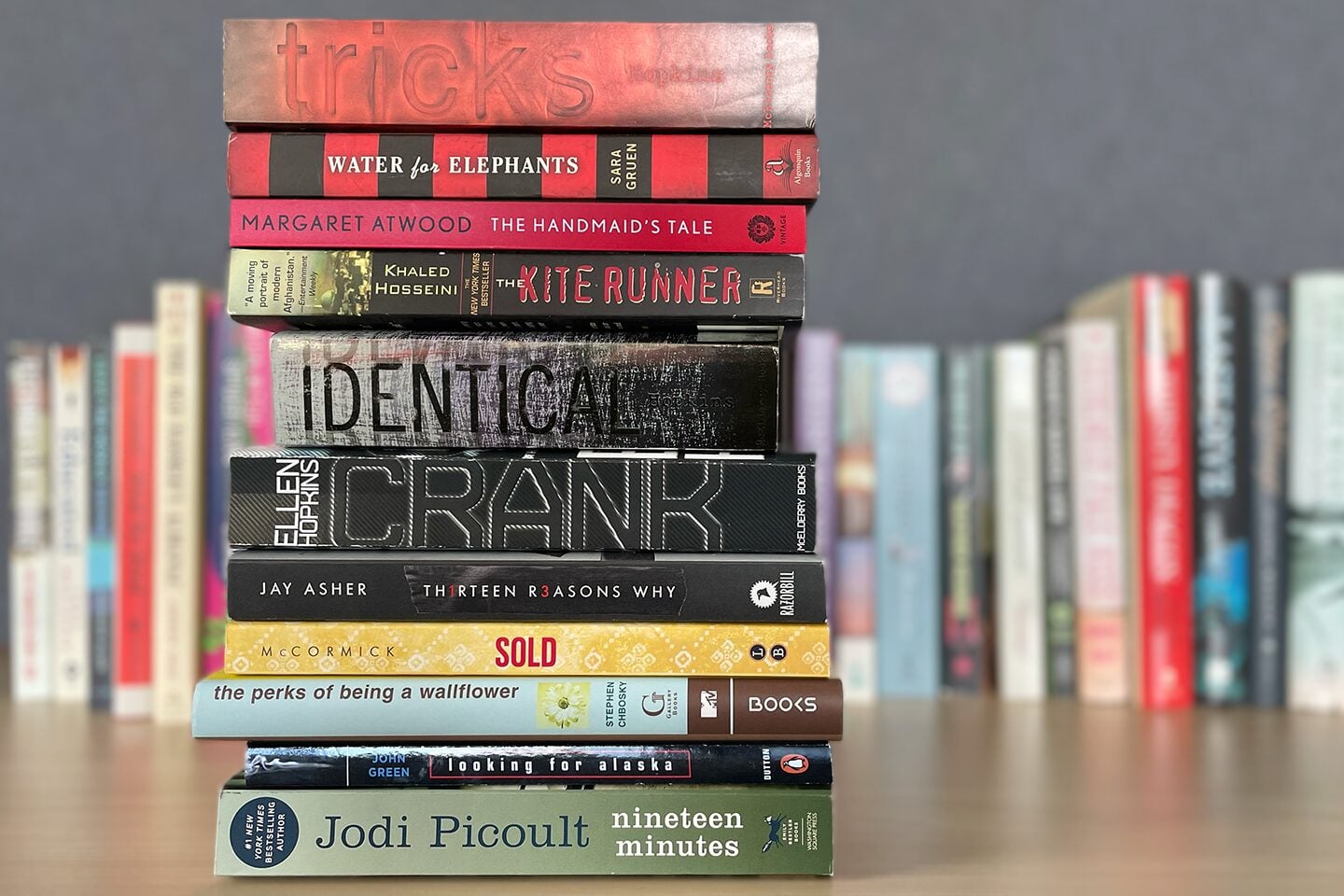
    I forhold til lesekunnskaper er vi vel på dårlige veier her til lands også. ettersom stadig flere ungdommer mangler konsentrasjonsevne til å lese lenger tekster og ikke minst bøker..
     
  • Laster inn…

Diskusjonstråd Se tråd i gallerivisning

  • Laster inn…
Topp Bunn