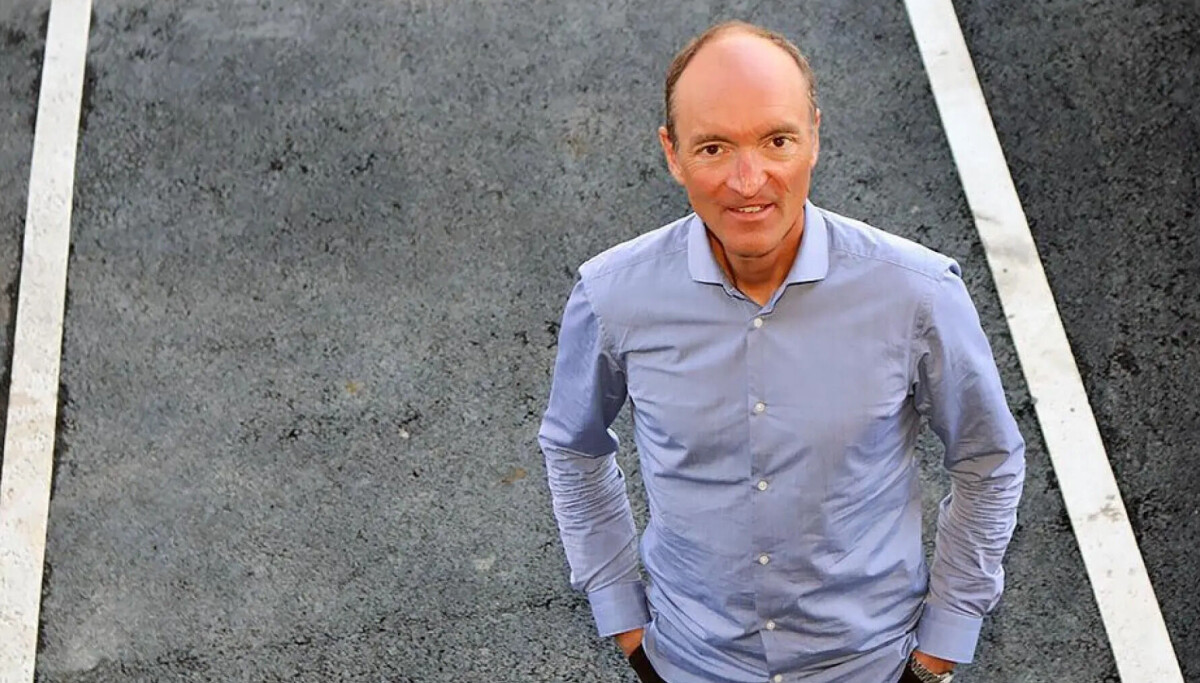
Litt av en fyr han Feynman, der er en grunn til at han er i signaturen min..
den "forelesningen" er AI-generert. Feynman holdt aldri en slik forelesning.Det betyr ikke at poengene ikke er relevante eller at han ikke har tenkt gjennom de eller snakket om de, men det er fortsatt AI-generert.
Feynman var selvsagt brilliant, uansett hvor mye AI-generert dette måtte være. Jeg pleier å referere til han som den største fysiker knapt noen utenfor feltet faktisk har hørt om. Alumen har hørt om Newton, Einstein og Richard Hawkins - sistnevnte bissart nok mange som tror er en av menneskehetens største fysikere. Niels Bohr om man er litt inne i grøten.
For ikke AI-generert innhold, er et et referat for en forlesning han holdt da han jobbet på Manhattan-prosjektet. Husk da på at publikum er USAs og den vestlige verdens fremste fysikk- og matematikkhjerner.
Meanwhile, under the influence of this primal dissection of mathematics, Feynman retreated from pragmatic engineering long enough to put together a public lecture on “Some Interesting Properties of Numbers.” It was a stunning exercise in arithmetic, logic, and — though he would never have used the word — philosophy. He invited his distinguished audience (“all the mighty minds,” he wrote his mother a few days later) to discard all knowledge of mathematics and begin from first principles — specifically, from a child’s knowledge of counting in units. He defined addition, a + b, as the operation of counting b units from a starting point, a. He defined multiplication (counting b times). He defined exponentiation (multiplying b times). He derived the simple laws of the kind a + b = b + a and (a + b) + c = a + (b + c), laws that were usually assumed unconsciously, though quantum mechanics itself had shown how crucially some mathematical operations did depend on their ordering. Still taking nothing for granted, Feynman showed how pure logic made it necessary to conceive of inverse operations: subtraction, division, and the taking of logarithms. He could always ask a new question that perforce required a new arithmetical invention. Thus he broadened the class of objects represented by his letters a, b, and c and the class of rules by which he was manipulating them. By his original definition, negative numbers meant nothing. Fractions, fractional exponents, imaginary roots of negative numbers — these had no immediate connection to counting, but Feynman continued pulling them from his silvery logical engine. He turned to irrational numbers and complex numbers and complex powers of complex numbers — these came inexorably as soon as one from facing up to the question: What number, i, when multiplied by itself, equals negative one? He reminded his audience how to compute a logarithm from scratch and showed how the numbers converged as he took successive square roots of ten and thus, as an inevitable by-product, derived the “natural base” e, that ubiquitous fundamental constant. He was recapitulating centuries of mathematical history — yet not quite recapitulating, because only a modern shift of perspective made it possible to see the fabric whole. Having conceived of complex powers, he began to compute complex powers. He made a table of his results and showed how they oscillated, swinging from one to zero to negative one and back again in a wave that he drew for his audience, though they knew perfectly well what a sine wave looked like. He had arrived at trigonometric functions. Now he posed one more question, as fundamental as all the others, yet encompassing them all in the round recursive net he had been spinning for a mere hour: To what power must e be raised to reach i? (They already knew the answer, that e and i and π were conjoined as if by an invisible membrane, but as he told his mother, “I went pretty fast & didn’t give them a hell of a lot of time to work out the reason for one fact before I was showing them another still more amazing.”) He now repeated the assertion he had written elatedly in his notebook at the age of fourteen, that the oddly polyglot statement e πi + 1 = 0 was the most remarkable formula in mathematics. Algebra and geometry, their distinct languages notwithstanding, were one and the same, a bit of child’s arithmetic abstracted and generalized by a few minutes of the purest logic. “Well,” he wrote, “all the mighty minds were mightily impressed by my little feats of arithmetic.
Min nærmeste leder er matematiker og smart as fuck, jeg spurte han en gang hvorfor minus og minus blir pluss, det kunne han ikke svare på der og da.




 spectrum.ieee.org